Hannah Hutchings-Georgiou uncovers themes in works by Saskia Colwell, on view in her exhibition Skin on Skin at Victoria Miro Venice.
-
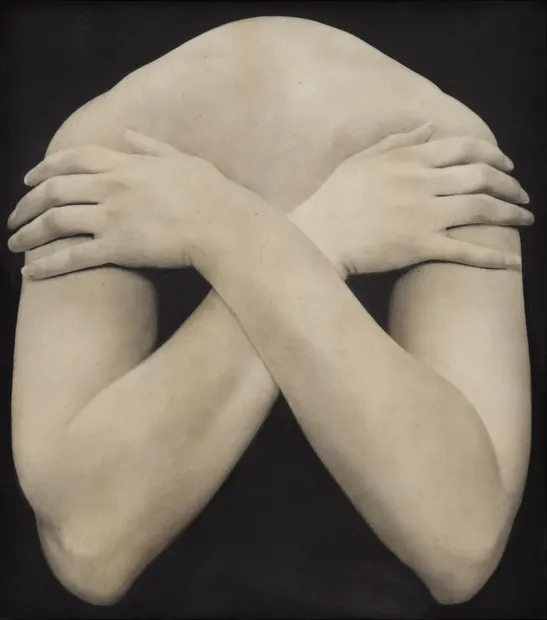
There is a wall of mirrors in Saskia Colwell's compact studio. From the opposite window, light inevitably hits the polished surface and skims the soft skin of her works, in charcoal on vellum, on the wall. At the slightest touch, this panel of mirrors slides to the side to reveal her cabinet of curiosities: books on modernism, feminist diatribes on porn, new materials, old artworks, treasured scraps of things unused or unworn. That sliding door, the snug studio scene reflected on one side, the world of knowledge on the other, mirrors my sense of what Colwell reveals and conceals in her drawings. At first glance: a picture-perfect portrayal of the body, albeit a betrayal of beautifully rendered parts at the expense of the whole. Yet when I look closer, when I slide the mirrored image to the side in my mind, I'm met with an alternative exposition, a unique vision of self and form - and art - unlike any reflected in the glass of a camera lens or a wardrobe door. Slide the image, flip the switch, skirt the delicate seam of warm thoughts lightly brushed with a powdery touch on calf's skin and a new body of knowledge opens to us, a new body turns, then closes.The body, claims feminist theorist Elizabeth Grosz, does not so much consist of inner and outer, of two antithetical substances, but, like a Möbius strip, is one continuous surface. Inside infers outside, outside implicates that which lies within. Colwell's works perform this magical inference (they go through the looking glass). That is, their surfaces hold hidden depths: beneath one epidermal layer exists another; upon seeing one body we espy several more. But her drawing goes beyond this mutual implication of formal practices and resurfacing forms by courting multiple tensions and seemingly irreconcilable opposites in the contours of her corporeal conceptions. Like Grosz's Möbius strip analogy, Colwell's drawings deliberately blur stylistic, visual and formal lines. They are neither nudes nor depictions of nakedness, as John Berger differentiates, but hover between the two, with their cheeky flashes of nudity and fictive claims to the naked truth of the body. And they are neither erotic nor pornographic, but, again, undress somewhere between the two, seducing then promising the viewer one vision of flesh when actually unveiling an alternate view. Existing at the interstices of the private and the public, the intimate and the distant, the licit and the illicit, the delicate and the crude, the classical and the contemporary, Colwell's drawings profess innocence even when they are ripe with knowing. Bordering on sculpted exactitude when completed in the softest of chalks and charcoal powder, her work delivers one thing, only to dare us to unwrap, to see, to touch, another.
-
 Saskia Colwell, Mask Off, 2024
 -
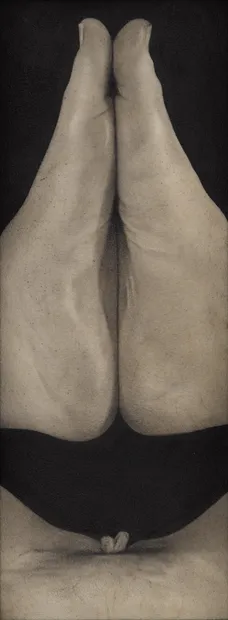
Praise the Lord, 2024, brings together all these fruitful (as well as fruity) contradictions. There is the pristine and perfectly symmetrical pairing of feet touching like two hands in prayer, a pas de deux unlike any before staged. And there is the open groin beneath, a clitoral bud of flesh poking upwards. Darkness frames these two bodily fragments, sublimely abstracting them further into a landscape of dense blacks and polished whites. If all we reductively see when looking at the provocatively titled Praise the Lord is just a cunt and some feet, then we’ve missed the point; equally, if we augment the composition into a visual field of concave spaces and hollows, a meditation of balanced tones and hues, opacities and transparencies, and open and closed elements, then we’re refusing to allow the grammar of the work to resolve into an entire sentence. Praise the Lord profanes the sacred in title alone, and only just erotically slips into the pornographic through its exposure of the vulva, but, like many of Colwell’s astutely composed drawings, it is an exercise in self-knowledge, and not so much the artist’s but our own. Abstracting the parts from the whole, the personal into the impersonal, Colwell attentively draws attention to the points and folds and zones, erogenous and otherwise, of the body that make us question ourselves and our way of seeing, knowing and grasping the world. She unsettles expectations by making us question what we initially see (‘Is that a pair of feet or hands? A clitoral or labial hood?’) and then further probes what we want to know and learn from the drawing (‘whose body am I looking at? Whose nudity foretells my own?’). With their diminutive framings and close-ups, their subtle gestures and the feminine-encoded history of (life) drawing itself, Colwell’s artworks create intimacy and proximity, but not necessarily between our body and hers. Instead they draw a relationship between our body and the one we dream of, the one we yearn for, the one we can never, ever, fully possess.Colwell’s artistic process nevertheless is one of dispossession, not possession. It is a deliberate act of undressing one form in order to address and dress up the final represented one. Taking photographs which frame parts of her naked body, Colwell then plots the outlines of these images on primed calf’s vellum. Using charcoal, charcoal powder and bone chalk, she extends the choreographed contortions of her body onto that of the vellum, so that the attitude in which her back bends or arches, her hips twist and her fingers pull and part folds of flesh is exaggerated or isolated from the original. Distancing her drawn figure from the photographed and actual ones (‘these are not self-portraits,’ she insists), Colwell performs self-discovery, self-inspection and self-gratification. She stages a kind of play of intimate connection and relation in order for viewers to connect with and relate to her work – and themselves. Is this tantamount to pornography, to the striptease, dances and poses rehearsed and enacted on film, in clubs, across centrefolds and Page 3 spreads? Does Colwell’s dispossession of her own lived body from her drawn ones push art back into the realms of the pornographic or the erotic? Though her work is monochromatic, answers to these questions are never black and white; aroused complicity may arise for one viewer, curiosity for another. What is certain is that these drawings are no longer about Colwell’s body or bodily actions, but what the body of art mediates and moves and imparts to us. When describing a nude by Rubens, Berger observed, ‘her body confronts us, not as an immediate sight, but as an experience…’ and it is this which Colwell invites us to see in her works too; the body not as ‘immediate sight’ or ‘site’, but as ‘experience’, as our encounter, our knowledge-making moment, our drawn desire to know.
-
Saskia Colwell, Praise the Lord, 2024
-
Then again, peeping and glimpsing, the eyes lingering too long on supple lines of skin, the round of a shoulder, the subtle caress, a crease of – well, these secular visions, this seduced gaze, could easily slip into voyeurism, into the staring, stalking, sinister kind of perception that Colwell depicts in her earlier works. There, peepshows cut into white-washed walls reveal Courbet-style vulvas, explicit like a dilated eye to stare right back at you. Larger works on linen, where Colwell is visible and espied from behind, implicate the viewer, ensnaring us further in this creepy act of eyeing her up. In these drawings, she positions us on the threshold between what is appropriate and inappropriate, pushing us into optical acts that make us question the politics and ethics of looking, even in viewing rooms like galleries and museums. Transforming the gallery into recesses that facilitate illicit pleasure, the peepshows further complicate the white purported neutrality of artistic and institutional spaces. Nevertheless, it was paper peepshows, lanterns and viewing boxes that brought about technologies of art and culture, as well as pornography and its voyeuristic ways of seeing, into our midst. In this, Colwell’s old works look to the new, as her close-ups and tight crops are reminiscent of the photographic digitised form from which they originate. Still interested in the gaze, in what it alights on and takes up, touches and gives back, in its powerful pull and the pleasure it admits as well as elicits, Colwell’s latest charcoal works, intimate studies in knowing and feeling and craving, carry something of the former optics and erotics of the peepshow, just from a safer distance. ‘It is the flash itself which seduces,’ says Roland Barthes, and in this, Colwell knows that it’s not just in what she flashes but in what she chooses not to flash that keeps us looking – and longing.In her analysis of the female body in the history of art, Lynda Nead pauses to consider the etymology of the word ‘obscenity’. A modification of the Latin for ‘scena’, ‘obscene’ literally means ‘what is off, or to one side of the stage, beyond presentation’. Nude representations of women’s bodies are often centre stage, instead of to the side of it. Yet, they have historically been subject to obscenity laws. Colwell may be creating art at a time when age-restrictive laws around pornography are rarely enforced, but she has still encountered censorship, not least on social media platforms like Instagram, around her depiction of the female form. This has forced her to be more creative, more oblique, to tip the mirror, to stand to one side of the stage and keep what is considered ‘obscene’ ‘beyond presentation’. Full frontal images are, therefore, obscured to the point of incoherence, whereas innocuous outlines of limbs and extremities are rendered rude through the suggestive poke and tug of flesh between fingers. Orifices appear where they are not and do not appear where they should be. This is Colwell hitting back at the hetero-patriarchal policing built into algorithms, at AI’s pretension to ‘know’ what is risqué from what is actual risk. By flirting with the rules and throwing parts of the body literally into shade, Colwell’s supposedly obscene explorations and offensive expressions of the female form highlight the real obscenity on display: the control of women’s bodies, the censoring of their expressions of sexuality and pleasure unless presented in a palatable way. Performing another kind of trick, Colwell moves her eroticised forms and formalised erotics into the spotlight, kinkily placing pressure and emphasis on points of the body usually considered not so much obscene, but unworthy of our attention, like the feet, a new kind of fetish, or the thumb against a shin, though this is suggestive of so much more.
-
Saskia Colwell, Cookie Jar, 2024
-
Transformations of the obscene into the obliquely erotic, the mundane into the marvellously sensual are achieved precisely because of Colwell’s employment of charcoal. Technically perfect, her drawings perform another spell whereby the assumed messiness, freedom and play that one associates with charcoal is finessed into its opposite: into precision, a controlled yet sensitive line and a sense of shadow and light unbelieved until seen with your own eyes. That this immaculate rendering of skin is charcoal powder – not always sticks – is even more impressive. But what really completes the transformation of messy materiality into near-marbled perfection is the calf’s vellum employed instead of traditional linen, paper or parchment. Skin on skin, as Colwell herself has described it, this once-living, now dead, organic surface, adds additional layers and depths to her works; a new metaphor surfacing when it comes to the types of contact and touch initiated on the drawn plane. Vellum ages and reacts to its environment; charcoal, though fixable, needs to be ‘touched up’, as Colwell aptly puts it, too. Tension turns to harmony when the natural veins of the vellum emerge across the unclothed back of one of Colwell’s works. Here, what could appear alarmingly visceral reappears as pure and beautiful, the knowledge of two bodies dissolving into one. It is the practicalities and material realities of these mediums and how Colwell astutely handles and works with them that achieves the thrill, the brilliance, the erotic charge and affective connection in these ‘private views’.
Text © Hannah Hutchings-Georgiou