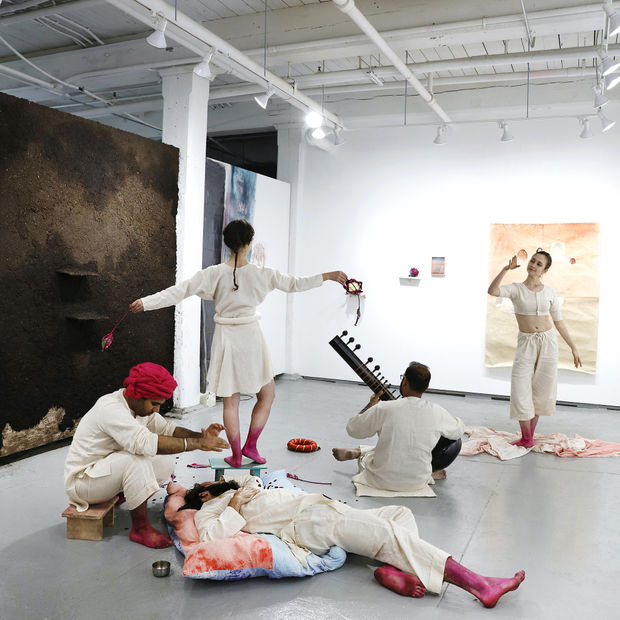
Rattanamol Singh Johal traces a synthesis of painting, music and embodied practice, rooted in the raagmala tradition, in the works created by Kuldeep Singh for his 2026 Victoria Miro Projects exhibition Lucid Body Elixir Terrain.
-
In the 1877 text The School of Giorgione, the British aestheticist Walter Horatio Pater famously declared, ‘All art constantly aspires towards the condition of music,’ underscoring the artist’s attempts to obliterate the distinction between matter and form. For Pater, the goal is for artistic form to ‘become an end in itself’ and to ‘penetrate every part of the matter,’ something that music successfully achieves and painting consistently strives towards.
In late medieval and early modern India, art and music achieved representational synthesis in the raagmala, a form of painting developed and practised in the princely courts of Punjab, Rajasthan and the Deccan, and referenced widely, including in Sikh scripture. A raag is the codified classical combination of musical notes that is closely calibrated with an hour, a season or a mood. The raagmala, literally a ‘garland of raags,’ collapses distinctions between image, sound and story by anthropomorphising and narrativising the raag’s attributes in a visual register. Here, each raag is depicted through a series of relationships between gendered protagonists and their progeny, architectural settings, colours, and times of day or night. Kuldeep Singh’s paintings dwell on this complex and varied tradition, remaking it through an embodied praxis and alternative imagination of its structuring relationships, interactions and forms.
-
 Kuldeep Singh, and thousand eyes, 2014. Performance at Skowhegan School of Painting and Sculpture, Maine. Image: Anna Garner
 -
Singh works with a specific set of raags and their corresponding moods: Raag Bhairavi (intense devotion), Hindol (playful reverie), Chandrakauns (tranquility, introspection) and Gaud Malhar (romance, longing). His works are not raagmala paintings in any conventional sense, which has earned them descriptors such as ‘neo’ or ‘queer’ in relation to this aesthetic genealogy. As a trained Odissi dancer, classical musician, and painter, Singh’s lived synthesis of the arts has catalysed a practice that is uniquely interdisciplinary and experimental. In the past this has led him into explorations of installation, performance and video, where the body of the viewer/participant/performer/artist is phenomenologically and affectively implicated. Works like and thousand eyes (2014), Architectonics of Dispersion (2017) and Still Here (2021) stage the sensual body as a site for projection and pleasure. His previous solo exhibition, Nakhra: Towards Sacred Sensuality, turned a Bombay apartment-gallery into a salon for slow, desirous looking that was occasionally punctuated by a musical or choreographic interlude orchestrated by the artist and his collaborators.
-
Kuldeep Singh, Architectonics of Dispersion, 2017. Performance at OyG Gallery, Brooklyn. Image: Zhiyuan Yang
-
In the new series of work produced for the exhibition, Lucid Body Elixir Terrain, Singh transitions deftly between painting, movement and music. As the sound of the tanpura fills his studio, canvas and paint guide spontaneous composition. He begins with the top and edges of the canvas, allowing for intuitive sketching and the build-up of pigment. Channelling the atmosphere created in the studio, the body moves through various stages of preparation, anticipation (associated with shringaar, a state of desire and longing), and execution. While previous painterly endeavors often resulted in figural emergences and intimacies on the picture surface, the new series of work favours resonant abstraction (spandan in Sanskrit literature), exuding a newfound confidence in the handling of scale and composition.
-
Kuldeep Singh, Ivory Ascending, 2025
-
In Ivory Ascending (2025), the luminosity of the painting's centre – with its corresponding sense of a new birth or beginning – is achieved through contrast (with the work's edges) and layering. There is a restraint here, the result of a push and pull between the pigment and painted space that the artist engages in but knows when to step away from. He moistens the surface of the canvas before applying paint quickly, adjusting viscosities, dabbing and smearing until the pigment covers the surface, becoming denser and more saturated with each layer. The cobalt violet, amethyst, ultramarine blue and gold green of Singh's palette are all weighty expressionistic colours, drawing the viewer into the energetic force field and throbbing musicality of the work.
-
Kuldeep Singh, Oscillators, 2025
-
Oscillators (2025) brings together various characteristics of Singh’s practice – figurative and abstract, topography and terrain, sensual and situational – evoking a mood of vivacious restlessness in the two figures who seem suspended in reverie on a bed of agitated colour. In Elixir Terrain I and II (both 2025), Singh imagines, ‘both the land being a body, and the body being land itself.’ Here and elsewhere bodies are turned away from the viewer and lost in thought, evincing a kind of interiority. A sinuous line brings them into being, and their emergence on canvas concretises the animating idea or impulse of the work, turning figures into vectors of affective and sensual appeal. Here we see the conceptual link to the raagmala tradition rather than a facile revival of its conventions.
-
‘Here we see the conceptual link to the raagmala tradition rather than a facile revival of its conventions.’
-
Each room in the exhibition is conceived as an enveloping environment, bringing together work of different scales and visual qualities with a classically arranged musical composition, a combination that conditions spectatorial engagement, drawing us into a situational community with thinkers and healers, lovers and mystics, painting and music.
Rattanamol Singh Johal
Text © Rattanamol Singh Johal
All works © Kuldeep Singh -
Explore gallery exhibitions
-
Adriana Varejão: Modernisms
12 September – 31 October 2026 VeniceThis body of work is conceived in direct dialogue with the artist’s participation in the Brazilian Pavilion at the 61st International Art Exhibition of La Biennale di Venezia. While the tile... -
Hernan Bas: TIME TO SHINE! (the salesmen)
17 September – 14 November 2026 London Gallery IThe exhibition focuses on overlooked characters – from a perfume counter attendant and a gallerist who specialises in ‘cat-made painting,’ to a man who sells seashells by the seashore –... -
Khalif Tahir Thompson: Send in the Clowns
8 October – 7 November 2026 London Gallery IIIn these new paintings, Thompson invites viewers into the everyday lives of his subjects through vibrant domestic scenes, creating scenarios from his own childhood growing up in Brooklyn and today. -
Alchemies: May Cockcroft, Nour Malas, Sarah Martin-Nuss
13 November 2026 – 23 January 2027 London Gallery II, Miro PresentsThree emerging abstract painters whose distinct practices transform colour and material into evocative visual languages. -
Celia Paul: Objects of Desire
7 November – 12 December 2026 VeniceNew paintings examining the act of looking and being looked at. The exhibition coincides with the publication of a new book by the artist, Objects of Desire: An Artist in Venice, a... -
Conrad Shawcross: Shadows of the Mechanism
26 November 2026 – 23 January 2027 London Gallery IThe debut of a significant new body of work, Time Pebble, and an immersive, multi-sensory installation of the artist’s acclaimed series, Slow Arc inside a Cube.
-
-
LIVE / ARCHIVE
An immersive journey through our programmatic strandsExperience our galleries from wherever you are in the world