Lorenzo Giusti
-
In a burning world, salvation depends on the ability of every being to adapt, to care, to transform. Lilith, one of the protagonists of Isaac Julien’s most recent work All That Changes You. Metamorphosis (2025) played by Sheila Atim, is inspired by Octavia E. Butler’s Parable of the Sower (1993). Julien’s Lilith is centred on the idea of change and transformation, using empathy to save an Earth devastated by climate collapse, the breakdown of social structures, systemic violence and the loss of meaning and a future never lived.Lilith seems to embody the ambivalence of metamorphosis: it is adaptation, but also loss; it is survival, but at the cost of transforming identity, species and gender. ‘I cannot remember how it was in the innocence of the world, before contamination . . . ’, Lilith says at the opening, evoking that nostalgia for a rigidly defined ‘human’ that Butler’s novels so often challenged. Innocence is a construction, a fiction. Every origin is already hybrid.The speculative trajectory of the possible evolutionary reality of the human species irradiates Julien’s entire new work, in which metamorphosis presents itself as a beyond: beyond gender, beyond species, beyond linear temporality. As Naomi, Lilith’s white alter ego, says in one of the central passages: ‘We are not in control, even of ourselves. Everything is in flux, including our ability to survive, maybe the task is to become capable of response.’
-
‘Julien’s Lilith [played by Sheila Atim] is centred on the idea of change and transformation, using empathy to save an Earth devastated by climate collapse, the breakdown of social structures, systemic violence and the loss of meaning and a future never lived.’
– Lorenzo Giusti -
 Isaac Julien, Cosmic Narcissus (All That Changes You. Metamorphosis), 2025
 -
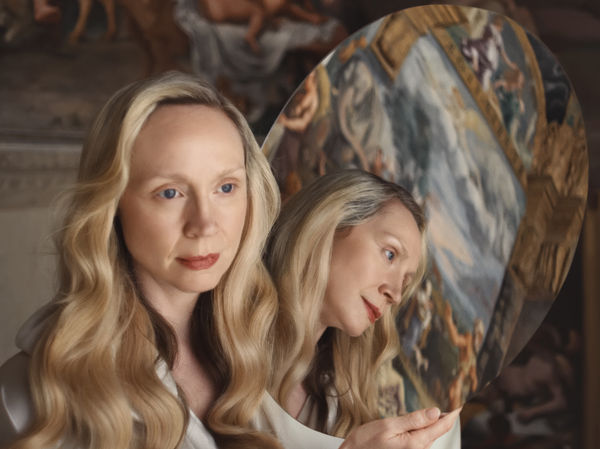
Played by Gwendoline Christie, the character of Naomi is inspired by the figure of Mary, the scientist and interstellar traveller who is the protagonist of Naomi Mitchison’s novel Memoirs of a Spacewoman (1962). If Lilith is a post-human voice of wisdom, heir to contamination and shared survival, Naomi emerges in the dialogue as a more earthly and meditative entity with a human perspective, of someone who has experienced the pain of loss, the disorientation of inheritance, and who confronts time as a continuous and unstable flow.In Memoirs of a Spacewoman, Mary communicates with extraterrestrial beings through empathy and respect. Mitchison imagines a world in which the frontiers of the self are not boundaries to defend, but porous territories to be crossed. The characters of Lilith and Naomi seem to embody this legacy: in them we recognise the desire to learn from living beings, to become capable of response and to inhabit time as shared responsibility.Naomi carries within herself the memory of her late mother, also a scientist – an absence that shapes her awareness. She is a descendant, a daughter of exploration and memory. While Lilith seems to come from an already hybrid future, Naomi is still in the making. ‘Each moment brings a metamorphosis,’ Naomi states, and in this phrase her vision is concentrated: not catastrophe, but flow, a continuum. She is a permeable, porous consciousness, traversing space-time not to dominate it but to understand it, in vulnerability and empathy.
-
Isaac Julien, After Eros (All That Changes You. Metamorphosis), 2025
-
Staying with the TroubleThe dialogue between Lilith and Naomi suggests that there is no time to wait for transcendent salvations or restorations of a lost past. Survival is built in the present, through risk, in the negotiation with the other. As in Butler’s Parable, it is also a prophetic, visionary act: imagining another community, another possible world. Where identity is fluid, relation is central, and metamorphosis is the only form of salvation. As Donna Haraway might say, it is a matter of coexistence, of ‘becoming-with’.Haraway’s presence at the opening of the film marks a fundamental theoretical and imaginative threshold. Her voice inaugurates All That Changes You with a reflection that is both a statement of intent and an interpretive map: ‘Trouble is an interesting word. It derives from a thirteenth-century French verb meaning to stir up, to make cloudy, to disturb.’ Her words open a space in which metamorphosis is both an epistemological practice and an ethical stance. Reading passages from her book Staying with the Trouble (2016), Haraway invites us to remain in the troubled present, renouncing both the seduction of a salvific future and the nostalgia for a lost past. It is an exhortation to live in the midst, in the murky and unfinished.The choice to foreground Haraway at the start of the film is an anchoring – a living genealogy of a thought that has revolutionised the way we imagine the relationship between species, bodies, technologies and narratives. It is no coincidence that Butler is also one of Haraway’s main sources of inspiration; she cites Butler as a key figure in her idea of ‘speculative fabulation’.
-
‘The dialogue between Lilith and Naomi suggests that there is no time to wait for transcendent salvations or restorations of a lost past. Survival is built in the present, through risk, in the negotiation with the other.’
– Lorenzo Giusti
-
In the film, her lesson unfolds as an ethics of multispecies coexistence. Naomi and Lilith are its heirs: one in a state of empathetic and transformative learning, the other in the wisdom of hybridity and trauma. But it is Haraway who opens the passage: not a goddess or a guide, but a companion in thought, inhabiting the complexities of the present with clarity and irony.Haraway’s position is also profoundly political: Staying with the Trouble is a fierce critique of the logic of salvation and linear progress. Instead of imagining a perfect future, Haraway invites us to weave relationships in the present, to build improbable kinships, to think of survival as a collective practice of care and transformation.If Haraway provides the framework that shapes the speculative structure of Julien’s film, the dialogue between Lilith and Naomi opens onto a wider constellation of thought revolving around the ‘Santa Cruz School’ – a theoretical and critical crossroads where some of the most radical reflections of contemporary post-humanism have taken shape. Julien and Mark Nash, co-authors of the script for All That Changes You. Metamorphosis together with Vladimir Seput, both teach at the University of California, Santa Cruz: the theoretical universe that emerges from their work is rooted in the same network of relations, affinities and speculative practices that characterise this academic and creative environment. -
Isaac Julien, Giants - After the Fall (All That Changes You. Metamorphosis), 2025
-
‘Julien constructs a path that does not follow linear logic, but a temporal choreography in which the places themselves transform (or transform those who pass through them).’
– Lorenzo Giusti
-
Narrating SpacesIn All That Changes You. Metamorphosis, architecture is not a mere scenographic backdrop but a true symbolic and dramaturgical agent. Each environment traversed by the protagonists possesses its own temporal, affective and sensory identity, contributing to the construction of a worldview in which architecture participates in metamorphosis.Palazzo Te presents itself as a true co-protagonist of the work. It is an active, dialoguing presence that embodies and amplifies the theme of metamorphosis. Built in Mantua between 1525 and 1535 by Giulio Romano, the suburban villa was commissioned by Federico II Gonzaga as a place of aesthetic experimentation. The very design defies the rules of Renaissance classicism; perspectival games, proportional distortions, frescoes laden with ambiguity and mythological allusions make the palace an exercise in the destabilisation of visual and symbolic norms.The fulcrum of the visual narrative is the celebrated Sala dei Giganti (Room of the Giants), a circular room whose walls and ceiling are entirely frescoed with the apocalyptic depiction of the fall of the Titans, struck down by Jupiter’s fury. The illusionistic ‘all-over painting’ technique draws the viewer into a dizzying spiral of destruction and metamorphosis: bodies deform, spaces collapse, perspectival scales dissolve. Julien captures this visual energy and reinterprets it as a metaphor for the collapse of classical humanism and contemporary society. From here, from the centre of crisis, departs the spaceship that will carry our travellers into another, more fluid space and time. Palazzo Te thus embodies both crisis and the possibility of renewal.The other rooms of the palace also contribute to the semantic fabric of the film. In the Camera di Amore e Psiche, which sequentially narrates Ovid’s fable of Cupid and Psyche, the theme of transformation through love and pain is recalled in the choreography of the bodies. In the Sala dei Cavalli (Room of Horses), by contrast, the monumental depictions of steeds are destabilised by the protagonists’ sinuous movement. These spaces, originally conceived to glorify a masculine, military and hierarchical vision of power, are reinhabited by Julien with post-human female bodies, who dismantle the dominant iconography and resemanticise its visual apparatus.Other architectural spaces, alongside Palazzo Te, contribute to the script of Julien’s film. The Cosmic House designed by Charles Jencks (1939–2019) in London opens up the possibility of irony, contamination among different cultural codes, the distortion of meanings and symbolic disorientation. By contrast, Richard Found’s private residence in the Cotswolds is a glass capsule that gestures towards a futuristic dimension of change, where metamorphosis resides in transparency and suspension. Glass becomes a sensory membrane, a perceptual threshold between inside and outside, between human and non-human.The Herzog & de Meuron pavilion, built for the Kramlich Collection in Napa Valley, represents a convergence of temporalities – a ‘device’ for interrogating the relationship between image and body, between projection and matter. In this pavilion, the protagonists no longer walk through space but move within the time of the image, traversing sequences, apparitions, and dissolutions.A fifth location is the Apollo capsule, designed by Timothy Oulton, first landed in the heart of a redwood forest – near Santa Cruz – and later, at the film’s close, in the centre of the Sala dei Giganti at Palazzo Te. The same scale as the historic Apollo 11 spacecraft and clad in polished steel, this hybrid structure – somewhere between fetish-object and sophisticated lounge – creates a disquieting short circuit: a hyper-artificial object, reflective and closed-in on itself, embedded in an ecosystem as monumental as it is fragile. The capsule no longer evokes the epic nature of space conquest but transforms into an inner chamber – a place where human subjectivity confronts its own ecological dissonance.In All That Changes You. Metamorphosis, every space is therefore a narrating body. Julien constructs a path that does not follow linear logic, but a temporal choreography in which the places themselves transform (or transform those who pass through them).
-
Isaac Julien, Metamorphosis I (All That Changes You. Metamorphosis), 2025
-
‘The film does not offer a single point of view, but a variable geometry of looking. There is no before and after, only reconfigurations of the present.’
– Lorenzo Giusti
-
Metamorphosis as Linguistic GrammarIn All That Changes You. Metamorphosis, metamorphosis is a true visual and linguistic grammar – a fluid and disjointed structure that interrupts linear narration, proposing another logic of looking and representation. The installation constructs a cinematic language that does not seek a centre, does not order vision according to hierarchies of meaning, but instead works through proliferation, overlap and deviation. The film choreographs rather than narrates.The dialogues between the two protagonists – drawn from the writings of Butler, Mitchison, Haraway, Anna Tsing, Ursula K. Le Guin and Carlo Rovelli – function as fragments of a thought in becoming, closer to speculative poetry than to dramatic storytelling. There is no traditional transformative arc; rather, each exchange is an inflection point in a process of continuous metamorphosis, in which subject, time and environment mutually recompose and dissolve one another.As Haraway affirms, ‘staying with the trouble’ means abandoning the reassuring teleology of the future – apocalyptic or salvific – in order to inhabit the ‘thick present’, the saturated space-time in which there are no resolutions, only imperfect and transitory configurations. The use of multiple screens reflects this logic: it does not resolve, it does not order, it does not explain. It disarticulates linear time and multiplies points of view, placing the audience in a condition of destabilized, yet active, listening.The protagonists move among quotations, memories, alternative futures and fluctuating affective states. Their bodies appear and disappear from one screen to another, duplicate, transform, rewrite themselves. Their visual presence is never fixed, but subject to continuous variation. As Naomi observes: ‘Each moment brings a metamorphosis.’ The disjointed and parallel editing confirms this: every sequence is an act of mutation, every screen an interface of transformation.The visual grammar of metamorphosis stands in opposition to the identity-based and causal logic of classical representation. ‘We are not in control, even of ourselves’, Naomi declares, articulating the principle that governs the entire concept: the subject as flux, vision as unstable process.The film does not offer a single point of view, but a variable geometry of looking. There is no before and after, only reconfigurations of the present. Lilith’s phrase ‘all that you touch you change, and all that you change, changes you’ also applies to the viewer: watching means being involved, traversed, altered. The installation activates an experience in which seeing becomes a reciprocal act.Within this metamorphic grammar, even verbal language loses its declarative function and approaches a form of song, a philosophical-emotional echo. When Lilith states that ‘love comes from difference, not from similarity’, she enunciates a principle that is as affective as it is visual: difference is not lack or distance, but a condition of generativity. Every image is formed in the contact between heterogeneities; every frame is a threshold, never a definition.The film embodies a landscape in constant transformation, where living matter becomes language. The sequences unfold like dream visions or ancestral memories: humid, intricate forests carpeted with moss, ferns and lichens alternate with close-ups of insects among flowers, amoebas, seahorses, bioluminescent jellyfish, starfish, iridescent forms, birds in flight, dogs running through the undergrowth, millennia-old rocks and cracking glaciers. These organisms are not subjects but signs in a visual alphabet that is continuously being redefined, transitional figures expressing the becoming of forms.A significant part of this iconography refers to the redwood forests of California, a sacred and ancestral ecosystem surrounding the University of Santa Cruz and one that inspired thinkers such as Haraway and Tsing. These trees, which live for millennia and communicate through roots and fungi, are living symbols of co-evolution, interconnection and resilience.In another section, the film expands from Earth to the cosmos: rockets, satellites, drones, the Earth seen from the Moon – all visions that further complicate the notion of scale and situate the human within a vast interspecies and planetary order. But this cosmology is not neutral: it is traversed by violence. Sequences of forest fires, evoking the devastations of climate change, show us blackened landscapes, fleeing animals and damaged trees, and prefigure the fall of giants frescoed by Romano in the Sala dei Giganti. Here, metamorphosis becomes catastrophe: structures collapse, fire rages, images fold in on themselves. But as in a vital cycle, destruction gives way to regeneration: the launch of a space capsule, new forests, hybrid forms emerging in the dark announce a possible new ecology, a future to be imagined beyond the end, where metamorphosis is survival, cohabitation and invention.
-
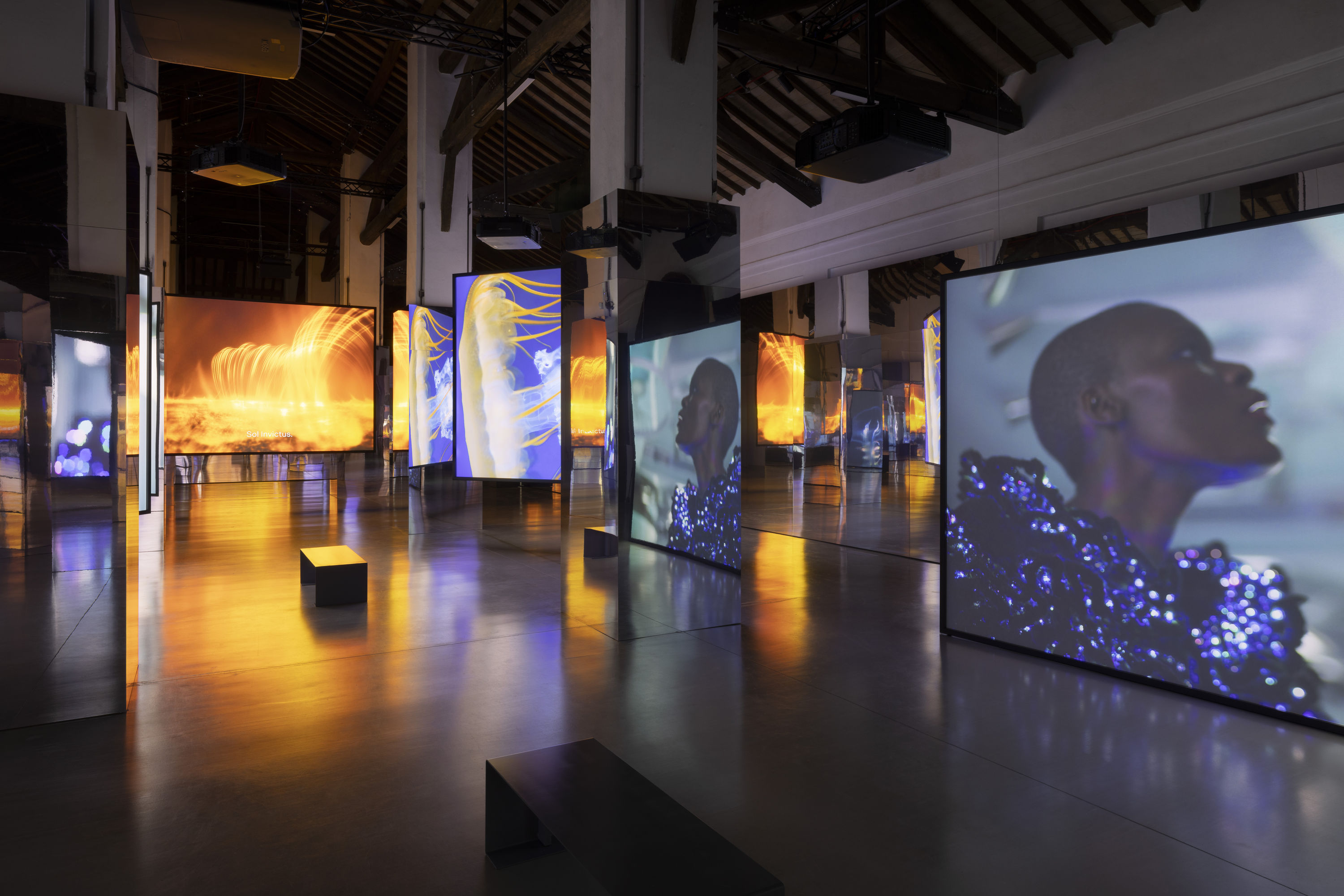
Installation view, All That Changes You. Metamorphosis, 2025, Palazzo Te, Mantua
Ten-screen film installation, 4K Video, colour, 10.2 surround sound, duration 23’37” -
‘The mirror becomes a conceptual device: no longer a threshold between subject and world, but a contact zone between human and non-human, between time and matter.’
– Lorenzo Giusti -
Visual LegaciesJulien uses reflective surfaces – especially those filmed inside Palazzo Te – not simply to replicate but to transform and disorient, to break historical linearity and multiply temporal planes. The reflection does not return an identity; it fractures, deconstructs, renders it porous. The mirror becomes a conceptual device: no longer a threshold between subject and world, but a contact zone between human and non-human, between time and matter. This dissolution takes on cosmological and political significance, because it invests every aspect of the image, from the microscopic to the planetary. It is living and cosmic matter that take centre stage. The image is never still: it pulses, changes state, alters consistency.Julien uses the installation medium to construct a temporal polyphony: it is a montage of times that coexist and contaminate one another. The time of art, the time of politics, the time of memory, the time of the body – all intertwine in stratified compositions, in which every image is subject to mutation.
-
Isaac Julien, Lilith's Moon (All That Changes You. Metamorphosis), 2025
-
More-Than-Human StoriesAll That Changes You. Metamorphosis both maintains and shifts the human away from the centre of the image, of discourse and of the world. It is not simply a matter of telling other stories from other perspectives, but of dismantling the ontological centrality that the human has historically occupied in myth, classical narratives and the narratives of modernity.The dialogues between Lilith and Naomi make this displacement explicit. Love itself, usually conceived as an interhuman phenomenon, emerges as an interspecies and inter-existential one: ‘It was from the difference between us, not from the affinities and likenesses, that love came.’ Otherness is no longer a threat, but the possibility for a relationship. Difference between organisms, languages, time and matter becomes the fabric upon which a new form of intimacy is built – one not founded on identity but on openness.The film consciously draws on a post-humanist and ecological horizon, where the human is no longer the measurer and regulator of the real, but one among many actors in an interdependent network of coexistences. ‘This world is not limited to humans’, says Lilith, introducing a radical ecological principle: every organism co-constructs the world, altering physical elements and, in doing so, also reshaping the possibilities of existence for others.
Within this framework, the human subject is no longer an organizing centre, but a fluid, permeable form. ‘All that you touch you change, and all that you change, changes you’ is not only a philosophical principle, but also an ethical-political vision of the world as a network of reciprocity. A sympoietic paradigm (Haraway) is asserted: no living being can exist or act alone.Visually, the installation reflects this decentring. The protagonists’ human bodies do not always occupy the centre of the frame. They often dissolve, fragment or are overwhelmed by natural or architectural elements. In some cases, the gaze itself is delegated to non-human agents: a drone that floats like an organism, an ‘other’ vision of the landscape.Temporal fragmentation also contributes to this process. Time is no longer linear, nor measured according to a human chronology, but follows a heterogeneous rhythm, made, as Lilith says, of ‘seasons not for us’, but for other life forms: stones, microorganisms, plant species. Time is not a uniform container, but a fabric of divergent temporalities, where the human must learn to inhabit incompleteness and coexistence.Finally, the decentring of the human is directly tied to the ecopolitical challenge of the work. It is not only about representing new subjectivities, but about rethinking responsibility: ‘We will become with each other, or we won’t be at all.’ On a wounded planet, survival can no longer be based on individualism, competition or human exceptionalism. What is needed instead is a practice of active and sensitive coexistence, a ‘response-ability’ that is not domination, but transformation.All That Changes You. Metamorphosis offers a pedagogy of metamorphosis: an invitation to learn from all living forms, from every material, from every crisis. There is no hierarchy among species or agents, but an ecology of co-creation. The film suggests that only through this willingness to be transformed – to become other – can the human find a form of survival that is neither violent nor solitary.Lorenzo GiustiCurator, Isaac Julien, All That Changes You. Metamorphosis, Palazzo Te, MantuaDirector, GAMeC, BergamoText © Lorenzo GiustiAll works © Isaac Julien, courtesy the artist and Victoria Miro -
Isaac Julien: All That Changes You. Metamorphosis