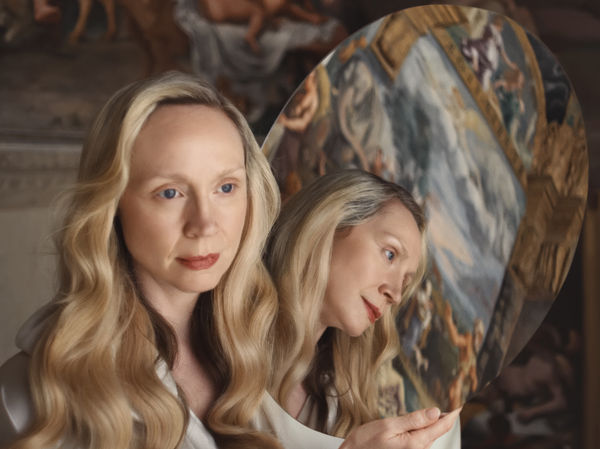
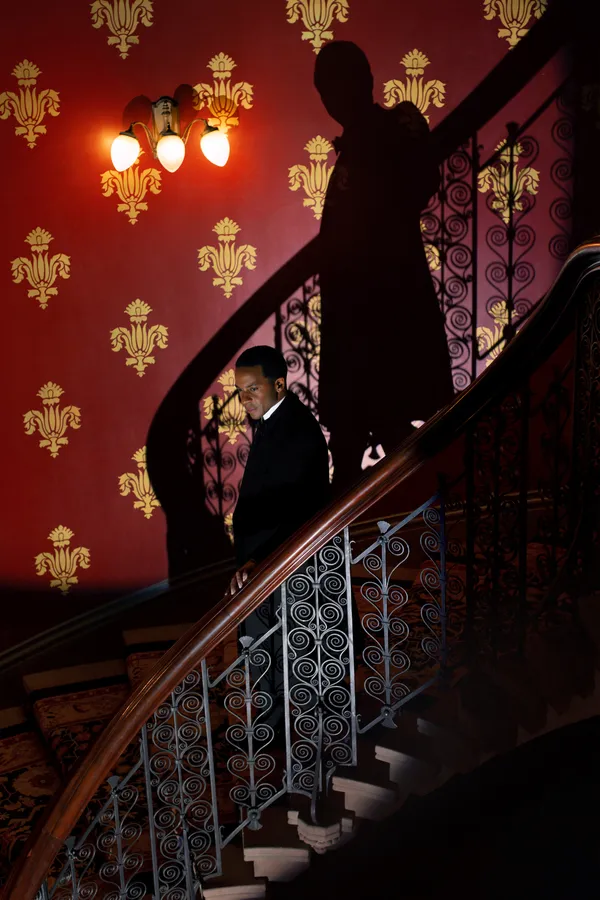
Victoria Miro is delighted to present the world premiere of the five-screen installation of Isaac Julien’s acclaimed film installation All That Changes You. Metamorphosis, accompanied by new photographic works.
All That Changes You. Metamorphosis, 2025, is a vivid, sweeping, visual poem about change, what it means to transform, to adapt and to survive. Commissioned to celebrate 500 years of Palazzo Te, Mantua, Italy (where it is currently on view) and exhibited here for the first time as a five-screen installation, Julien’s latest work moves between science fiction, philosophy, ecology and art, imagining new forms of life and identity beyond the human.
The work is accompanied by an extensive new essay by Lorenzo Giusti, Director, GAMeC, Bergamo and curator of Isaac Julien, All That Changes You. Metamorphosis, Palazzo Te. In addition, the photographic works on view feature commentary by Vladimir Seput.
-
 Isaac Julien, All That Changes You. Metamorphosis, 2025. Installation view, Victoria Miro, London
 -
‘Julien constructs a path that does not follow linear logic, but a temporal choreography in which the places themselves transform (or transform those who pass through them).’
– Lorenzo Giusti
-
Isaac Julien, All That Changes You. Metamorphosis, trailer
-
All That Changes You. Metamorphosis draws inspiration from thinkers who explore how transformation shapes who we are and how we live, including writers Octavia Butler, Naomi Mitchison, Ursula K. Le Guin and philosopher Donna Haraway. Their ideas weave through the film’s layered images and lyrical dialogue.Two protagonists are at the heart of the film, played by internationally acclaimed actors Sheila Atim and Gwendoline Christie. Atim’s character, Lilith, is inspired by two of Octavia Butler’s heroines, combined into one mythic figure who embodies transformation. Opposite her is Naomi, portrayed by Christie and loosely based on Naomi Mitchison’s science fiction novel Memoirs of a Spacewoman. While Lilith speaks from a posthuman future, Naomi remains grounded in the human present, searching for new ways to connect.
-
Isaac Julien, All That Changes You. Metamorphosis, 2025. Installation view, Victoria Miro, London
-
‘Lilith’s phrase “all that you touch you change, and all that you change, changes you” also applies to the viewer: watching means being involved, traversed, altered.’
– Lorenzo Giusti -
The work also draws on contemporary ecological and philosophical thinking from scholars such as Anna Tsing and Carlo Rovelli. Rovelli’s conception of time as something that does not flow independently but instead emerges from a web of relationships resonates with Haraway’s sense of interconnectedness, her insistence that all beings are entangled in shared processes of becoming. Together, these ideas are felt rather than stated, embodied in the rhythms of the film and in the ways Lilith and Naomi move, speak, and encounter their changing environments.
Presented across five screens within a mirrored environment, the installation encourages multiple viewpoints. Scenes overlap, dissolve, are reflected and reappear. Dialogue becomes poetry and time folds in on itself. The work does not provide solutions or complete answers, instead asking us to inhabit change, to see transformation as part of what it means to be alive. Time is now measured by the rhythms of earth, air, and fire. Isaac Julien invites us to look at the world in motion, and to imagine how we might change with it.
-
All that Changes You. Metamorphosis
From Science Fiction to Speculative FabulationBy Lorenzo Giusti
→ Read here -
Photographic Works
-
Installation view, Isaac Julien: All That Changes You. Metamorphosis, Victoria Miro, London
-
Isaac Julien, Metamorphosis I (All That Changes You. Metamorphosis), 2025
-
‘Julien’s Lilith [played by Sheila Atim] is centred on the idea of change and transformation, using empathy to save an Earth devastated by climate collapse, the breakdown of social structures, systemic violence and the loss of meaning and a future never lived.’
– Lorenzo Giusti -
Isaac Julien, After Eros (All That Changes You. Metamorphosis), 2025
-
Isaac Julien’s photographic works Metamorphosis I and After Eros of two goddesses in a playful encounter with the mirror, are inspired by the visual language of Italian sixteenth-century Palazzo Te and the fresco tradition that vigorously animates its interior. The characters of Naomi (Gwendoline Christie) and Lilith (Sheila Atim) draw from classical depictions of goddesses, and their presence is part of the long artistic history of the mirror – an object that has served both as a symbol of self-knowledge and as a threshold into other states of being. From Jan van Eyck’s convex mirrors to allegorical Baroque paintings, the mirror has repeatedly questioned how vision constructs reality, and these two works continue that line of enquiry where the mirror doesn’t show the expected image but the possibility of other worlds.
‘…their presence is part of the long artistic history of the mirror – an object that has served both as a symbol of self-knowledge and as a threshold into other states of being.’
– Vladimir Seput -
Isaac Julien, Cosmic Narcissus (All That Changes You. Metamorphosis), 2025
-
‘In Cosmic Narcissus and Lilith’s Moon Atim’s goddess Lilith embodies transformation across time and space. Like Caravaggio’s Narcissus, she faces her own image as both a temptation and a revelation.’
– Vladimir Seput
In Cosmic Narcissusand Lilith’s Moon Atim’s goddess Lilith embodies transformation across time and space. Like Caravaggio’s Narcissus, she faces her own image as both a temptation and a revelation. Yet she is not confined to a surface image as the mirror opens outward rather than reflecting inward. As a time-traveller in a futuristic spaceship she continues a journey of Jean Cocteau-esque cinematic imagination where mirrors become an entrance into dream states and memory – an act of crossing both mythic and personal.
-
Isaac Julien, Lilith's Moon (All That Changes You. Metamorphosis), 2025
-
‘…the mirror becomes a site where time folds. Its surface holds the past… but also opens on to alternative histories and imagined futures.’
– Vladimir Seput
Echoing the myth of Orpheus and Eurydice – whose love compelled a passage into the underworld and across the boundary between worlds – the mirror as a threshold through which the two goddesses move is taken again as a motif in Satellite – Orpheus and Satellite – Eurydice, passing into alternate realities that coexist with, distort or undermine the architectural world of the palazzo. Within this framework, the mirror becomes a site where time folds. Its surface holds the past – the fresco traditions, the classical narratives – but also opens on to alternative histories and imagined futures.
-
Isaac Julien, Giants - After the Fall (All That Changes You. Metamorphosis), 2025
-
‘She is reframing the Mannerist spectacle of collapse as a site of survival, witnessing and reconfiguration…’
– Vladimir Seput
Giants – After the Fall places Lilith – a Black goddess figure inspired by Octavia Butler’s writing – at the centre of the Sala dei Giganti, Giulio Romano’s immersive Renaissance fresco depicting the violent collapse of the Giants. By situating this contemporary, divine presence within a room historically associated with chaos, downfall and transformation from Ovid’s Metamorphoses, the work creates a powerful temporal and symbolic rupture as Lilith stands in quiet authority amid Romano’s illusionistic catastrophe. She is reframing the Mannerist spectacle of collapse as a site of survival, witnessing and reconfiguration rather than ruin. Giants – After the Fall reexamines the power of myth, foregrounding a figure historically excluded from such spaces while transforming the room from a narrative of destruction into one of enduring presence.
-
About Isaac Julien
-
Related
-
Frieze reviews Isaac Julien: All That Changes You. Metamorphosis
March 10, 2026‘With each repetition of the film, the cycle returns, daring us to think differently about how we arrived here and what we might become.’ – Sam Moore -
Forbes selects Isaac Julien: All That Changes You. Metamorphosis as a must-see exhibition
February 17, 2026'Like all of Julien’s works, this film is a lush visual feast that envelops the viewer.' -
On view in Madrid – Isaac Julien: Once Again… (Statues Never Die)
March 5, 2026Presented by Fundacion Calparsoro at the Museo Lazaro Galdiano, and shown for the first time in Spain, Julien's 2022 work explores the relationship between Dr. Albert C. Barnes, who was... -
Isaac Julien participates in the 2026 Media, Technology, and Culture Symposium
February 19, 2026The two-day symposium addresses some of the most critical challenges facing the field of media arts today, as well as to explore how video and media art can be sustained,... -
Artnet features Isaac Julien’s All That Changes You. Metamorphosis
October 3, 2025'Julien’s film takes our timeless fascination with eternal transformation and updates it with a futuristic, sci-fi twist.' -
Isaac Julien: All That Changes You. Metamorphosis at Palazzo Te
October 4, 2025On the occasion of its 500th Anniversary, the Palazzo Te Foundation presents a world premiere of a new film installation by Isaac Julien. Extended until 31 May 2026.
-
-
All That Changes You. Metamorphosis is produced by Palazzo Te in partnership with Mantua Films; Isaac Julien Studio; the Rosenkranz Foundation; Canyon; the Linda Pace Foundation; Jessica Silverman; the Jack Weinbaum Family Foundation; Mellon Fund; and the University of California, Santa Cruz.
The script was developed collaboratively by Isaac Julien, Mark Nash and Vladimir Seput.