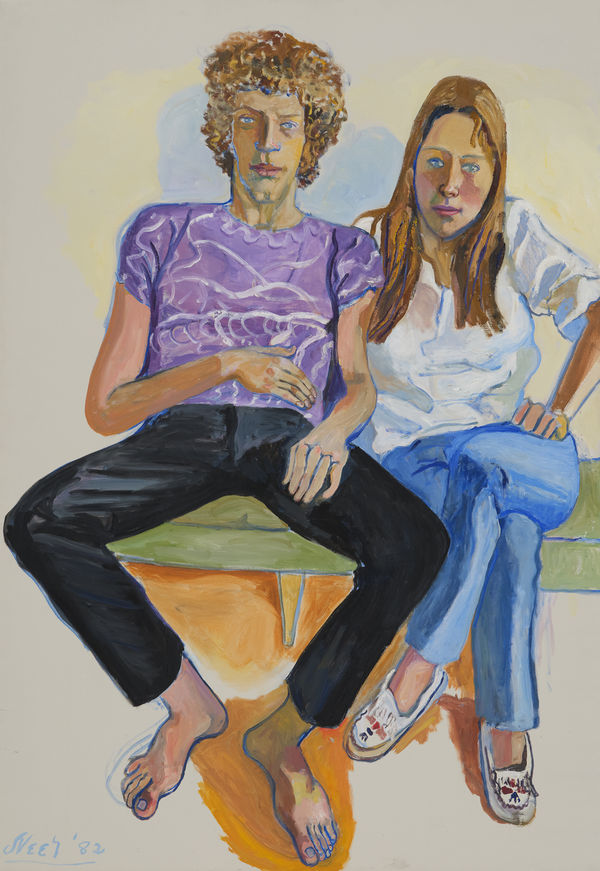
Victoria Miro is delighted to co-present with David Zwirner (Booth D09) a selection of paintings by Alice Neel as part of Frieze Masters’ curatorial initiative Queering Modernism: Visual Languages of the 20th Century, which foregrounds work that engages with queer experience and the representation of LGBTQIA+ subjects.
The presentation draws from the acclaimed exhibition curated by Hilton Als: At Home: Alice Neel in the Queer World, which debuted at David Zwirner Los Angeles in 2024 and was subsequently on view at Victoria Miro in London in 2025. It focuses on Neel's paintings of people from queer communities and those who were a part of their circle. Subjects are drawn from fields including philanthropy, law, writing and art, in addition to friends and neighbours – together forming a collective portrait that both embodies and complicates an understanding of the queer world of Neel's moment and the artist's place within it.
Also on view is related archival material that illuminates the lives and accomplishments of the individuals depicted by Neel and their surrounding historical and cultural contexts.
-
‘I don’t think Alice ever set out to “represent” anything. She painted her myriad, layered worlds. But what I loved – what I saw in the queer pictures – was a kind of family of difference, men and women and others who may have had relatively little understanding in America at that time but complete understanding in Alice’s universe.’
– Hilton Als talking to Wallpaper* about At Home: Alice Neel in the Queer World
-
John Cheim
 Alice Neel, John Cheim, 1979
 -
Richard Gibbs
Alice Neel, Richard Gibbs, 1965 -
Richard Gibbs’ Friend
Alice Neel, Richard Gibbs' Friend, 1962 -
-
Allen Ginsberg
Alice Neel, Allen Ginsberg, 1966 -
Neel met the celebrated American writer and Beat poet Allen Ginsberg (1926-1997) in 1959 on the set of Robert Frank and Alfred Leslie's film Pull My Daisy, in which they both appeared alongside other Beat poets and artists. In this work (painted by Neel from memory after seeing Ginsberg perform with Dr. Timothy Leary in 1966) the poet sits cross-legged next to a glowing candle, his torso and open-mouthed face surrounded by abstract, orb-like forms. The composition mimics the gritty, improvisational, and often frenetic style of poetry that Ginsberg and the Beats were known for, and speaks to the hallucinatory quality of their performances at the time.
A leading member of the Beat generation of writers who emerged around 1944 out of Columbia University, Ginsberg moved to San Francisco in the 1950s and, in 1956, published his best-known poem, Howl, to both great acclaim and controversy; in 1957 there was an obscenity trial against the poem due to its content, much of which was based on Ginsberg's relationship with the poet Peter Orlovsky (1933-2010). In his work, Ginsberg wrote openly about his identity and gay desire, in effect challenging the obscenity laws of the time and paving the way for younger LGBTQIA+ artists and writers to express themselves freely. Ginsberg read a poem at the memorial service held for Neel after her death in 1984 at the Whitney Museum of American Art.
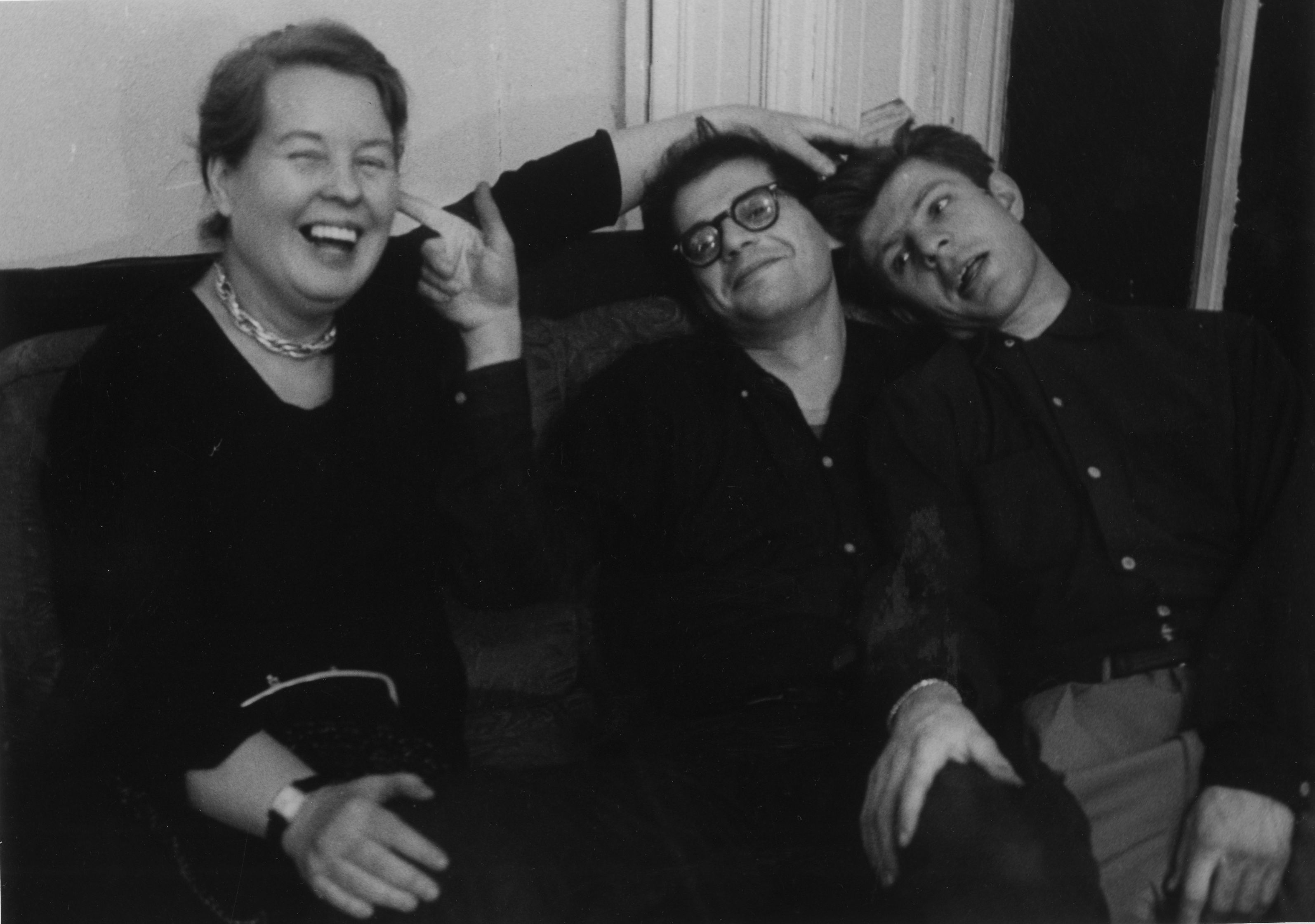
Alice Neel with Allen Ginsberg and Peter Orlovsky on the set of Robert Frank and Alfred Leslie’s Pull My Daisy, 1959. Artwork © John Cohen Trust, courtesy L. Parker Stephenson Photographs, New York
-
-
Edward Avedisian
Alice Neel, Edward Avedisian, 1959 -
Edward Avedisian (1937–2006) was a prominent abstract painter who was active in the 1960s New York art scene, having moved to the city from Boston in the late 1950s. With his friend, the artist Robert Smithson, Avedisian would attend Neel's exhibition openings during this time. As she recalled, 'I used to call Edward Avedisian "angel face".' Here, Avedisian is seen seated in a relaxed pose with a look of indifference on his youthful face. Neel renders his features and clothing – red striped cardigan, shirt and tie, dark trousers – in careful detail that contrasts with the loosely painted background.
-
-
‘…that blue line for which she is known – a quiet ache, a pathos, a vividness limning each body. She was the best at what she did and what she did best was push paint around in order to describe a subject’s vitality and distinctness of presence.’
– Sarah Lehrer-Graiwer, reviewing At Home: Alice Neel in the Queer World in Artforum
-
Kris Kirsten
Alice Neel, Kris Kirsten, 1971 -
Paul Kuyer
-
Paul Kuyer was a good friend of Neel’s whom she met through her longtime friend John Rothschild. At the time these works were completed, Kuyer was editor of The Civil Service Leader, a magazine for public employees. Neel recalled that he had considered becoming a priest and was a lover of opera; the duo attended the Metropolitan Opera together on at least one occasion. In 1959 Neel made two paintings of Kuyer: one more unfinished than most of her work, which highlights her economy of line; and a related, more fully composed work. Both paintings show Kuyer, his face serene, wearing a high-collared coat reminiscent of priestly garments.
-
-
Arthur Bullowa
Alice Neel, Arthur Bullowa, 1960 -
Alice Neel
-
Related
-
At Home: Alice Neel in the Queer World
Alice Neel's unstinting, visionary engagement with the lives of those around her resulted in an inclusive oeuvre. This aspect of queer representation in her work is explored for the first... -
Hilton Als speaks to Dazed about At Home: Alice Neel in the Queer World
February 12, 2025'Alice Neel gave us the opportunity to touch and understand each other, even if for a little bit.' -
Alice Neel: Beautifully Imperfect at Serralves Museum, Porto
July 13, 2026The exhibition (16 July 2026–17 January 2027) highlights how the American painter challenged the social, aesthetic and political conventions of the twentieth century. -
Curator Hilton Als talks to Wallpaper* about At Home: Alice Neel in the Queer World
January 31, 2025‘Ultimately what I loved about these “queer” pictures is what I love throughout her art: empathy devoid of sentimentality.’ -
At Home: Alice Neel in the Queer World reviewed in The Times
January 30, 2025★★★★ 'And this is Neel's skill, quite apart from her ingenious use of colour (her skins are superb, flaws and all) and keen observation. She draws out the person, gives... -
Art Review selects At Home: Alice Neel in the Queer World as one of its exhibitions to see in January
January 6, 2025’For Alice Neel, her practice of painting people from many walks of life, from neighbours to writers, performers, artists, politicians and activists – friends and strangers – led her to...
-
-
Frieze London Booth D12
-
All works © The Estate of Alice Neel
Courtesy The Estate of Alice Neel, David Zwirner and Victoria Miro